
With its chubby cheeks, its coppery gaze of magnetic depth, and its reassuringly rounded silhouette, the British Shorthair embodies a rare alliance between quiet strength and aristocratic elegance. Often compared to a living plush toy or to Lewis Carroll's famous Cheshire Cat, this feline from across the Channel has established itself as one of the most sought-after companions in modern households. But beyond its polished aesthetics, what does this silent and reassuring presence conceal? From the cobbled streets of ancient Rome to the hushed salons of the Victorian era, discover the facets of a breed with a gentle temperament, perfectly suited for the harmony of indoor living.
The origins of the British Shorthair: from Roman legions to Victorian drawing rooms
Far from being a recent creation of modern breeding, the breed draws its roots from a thousand-year history where pragmatism meets feline aristocracy.
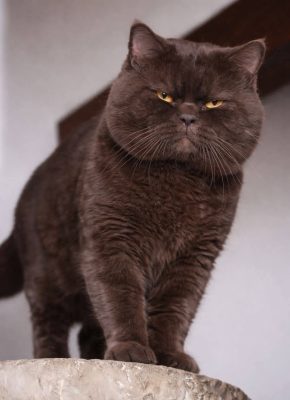
The legacy of camp cats
The story begins more than two thousand years ago. During the invasion of Britain by the troops of the Roman Empire, domestic cats were brought on board to protect food supplies and grain from rodents. Once settled on the British Isles, these sturdy felines interbred with the native wild cat populations. From this natural union was born a stocky animal, with a thick, waterproof coat, capable of braving the rigors of the island climate without faltering. For centuries, it remained the vigilant guardian of English farms and barns, valued above all for its bravery and efficiency as a hunter.
The consecration of the Victorian era
It was at the end of the 19th century that the perception of this working cat shifted. Harrison Weir, a tutelary figure of modern feline enthusiasm and a passionate artist, decided to select and elevate this sturdy alley cat. At the very first official cat show held at the Crystal Palace in London in 1871, the British Shorthair made a remarkable entrance and established itself against the then highly fashionable Oriental breeds.
Tested by the two world wars, the breed nearly became extinct in the middle of the 20th century. Passionate breeders then orchestrated targeted crosses with Persians to restore density to its bone structure, round out the contours of its head, and enrich its coat texture, definitively fixing the standard we admire today.
Morphology: the sculptural power of roundness
The British Shorthair standard is distinguished by a visual balance where every line expresses fullness and solidity.
A compact and powerful body
Defined by the term “cobby”, the British Shorthair’s physique commands respect. Its bone structure is heavy, its musculature dense, and its chest particularly broad. Adult males, which typically weigh between five and eight kilos (compared to three to five kilos for females), exude an impression of quiet strength. Their legs are short but solid, ending in firm, round paws, while their tail, thick at the base, finishes in a rounded tip.
An expressive head and a signature coat
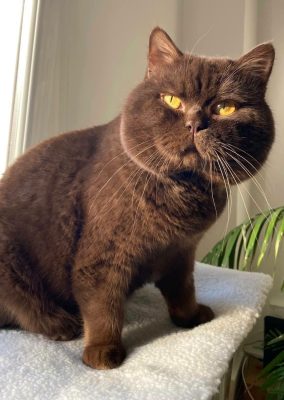
The head of the British Shorthair is undoubtedly its most striking signature. Perfectly spherical, it features full cheeks — particularly developed in males —, a short nose with soft contours, and small, widely spaced ears. Its eyes, immense and round, most often display warm hues ranging from deep copper to golden amber, although emerald green and intense blue enhance certain varieties such as the silver shaded or the colourpoint.
As for its coat, it resembles no other. Short and particularly dense, it has an abundant undercoat that gives it that unique, firm, and slightly "crackling" feel under the fingers, similar to a thick velvet carpet. While the blue coat remains the most iconic in the collective imagination, the breed displays a complete chromatic range: lilac, cream, chocolate, red, immaculate white, or bicolor and tabby patterns.
The character of the British Shorthair: the embodiment of British phlegm
If its silhouette seduces at first glance, the character of the British Shorthair constitutes the true secret of its success with families and lovers of calm.
A gentle presence without excessive effusion
The British Shorthair shines with its measured temperament. Phlegmatic, observant and discreet, it is neither intrusive nor distant. It appreciates the company of its humans and likes to stay in the same room, lying a few meters away or on the back of an armchair, taking part in home life with an attentive gaze or a soft purr.
Unlike certain breeds that demand constant attention, it cherishes its independence. It is generally not a fan of long sessions on laps or restrictive handling; it prefers to come and ask for affection on its own terms, savoring scratches behind the ears before returning to its contemplative nap.
An ideal companion for the family
Its legendary patience makes it an exceptional host for households with children. Not very reactive, it prefers to calmly move away to a high place when a situation becomes too noisy rather than showing aggression. It also coexists very easily with other pets:
With other cats: it shares its territory without exacerbated territorial rivalry.
With dogs: its natural calm avoids exciting the chase instinct of canines, allowing peaceful coexistence after a period of gradual introduction.
Apartment living: optimizing the environment for an indoor cat
Thanks to its calm nature and moderate activity level, the British Shorthair is the archetype of a cat suited to apartment living. However, ensuring its daily well-being requires some specific arrangements.
| Head & Expression | Body & Bone Structure | Coat & Texture |
|---|---|---|
|
|
|
Set up vertical pathways and retreat areas
Even if it doesn't spend its days leaping from one piece of furniture to another, this feline appreciates dominating its environment. To safely satisfy its need for height:
Install a particularly robust and stable cat tree, capable of supporting its weight without wobbling upon landing.
Set up secure window ledges to give it a vantage point to observe the outside world.
Place cozy baskets in quiet corners, away from drafts and frequent foot traffic.

Preventing a sedentary lifestyle and weight gain
The flip side of the British Shorthair's Olympic calm lies in its tendency toward a sedentary lifestyle. In an apartment, the lack of exercise combined with its compact build can quickly lead to excess weight, a factor that aggravates its joints and heart health.
To stimulate its physical activity without rushing it:
Divide its meals à l’aide de distributeurs interactifs ou de tapis de fouille, qui l’obligent à réfléchir et à bouger pour se nourrir.
Devote two to three play sessions per day of ten minutes each: feather wands, fishing rods or light balls awaken its predator instinct.
Vary the toys regularly to keep its curiosity alive.
Health and maintenance: the keys to a beautiful longevity
Naturally robust thanks to its rustic origins, this feline has an average life expectancy of between twelve and fifteen years. A few simple grooming habits help preserve its vitality.
Coat care and hygiene
Its dense and thick fur requires regular maintenance to limit the ingestion of hair and the formation of mats:
Weekly brushing: regular brushing with a natural bristle brush or a medium-toothed metal comb is sufficient under normal circumstances.
Shedding periods (spring and autumn): daily brushing becomes necessary to remove dead undercoat using a suitable tool such as a soft slicker brush.
Eyes and ears: occasional cleaning with a compress soaked in physiological lotion prevents the buildup of impurities in the ear canals and the corners of the eyes.
Preventive veterinary care
As with any purebred feline breed, particular attention must be paid to two pathologies of genetic origin:
Hypertrophic cardiomyopathy (HCM): a thickening of the heart walls detectable by regular echocardiography in breeding cats.
Polycystic kidney disease (PKD): the development of cysts on the kidneys, now ruled out by the majority of conscientious breeders thanks to preventive DNA tests.
A silent, tender companion of remarkable constancy, the British Shorthair brings an immediate atmosphere of calm to any home. Its sculptural beauty and its greatly benevolent character make it much more than a simple pet: a harmonious presence that enhances the gentleness of the household.